Reviewed · 2-DAY EXPERIENCES
2 Days best of Cairo & Giza private guided tour
This 2-day private guided tour is interesting because it strings together Cairo and Giza highlights in a smart order, so you go from the big pyramid skyline to city history without wasting half your time on logistics. I especially love the Egyptologist-guided pacing that keeps each site understandable, not just photo stops, and the private AC transport that makes the driving days feel manageable.
The other strong point I like is the balance between ancient Egypt, early Christianity, and Islamic Cairo, with stops like Saqqara and the Citadel in the same trip. One possible drawback to plan for is that a lot is packed into two days, so you will do real walking, and you may want to skip optional add-ons like going inside the pyramids if you prefer slower time at ground level.
Key tour highlights
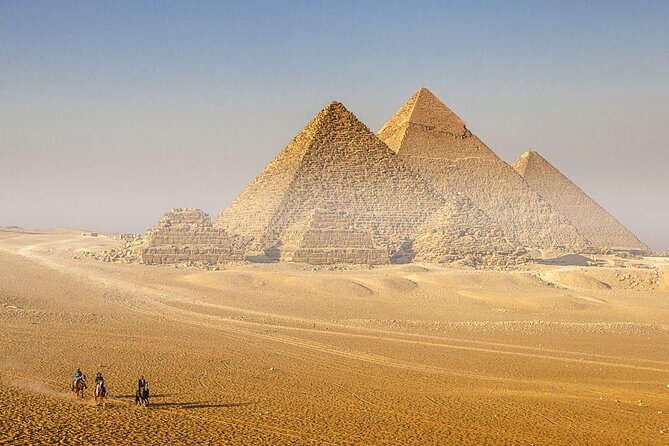
- Giza skyline and Sphinx moment: You see the Great Pyramid area, then hit classic viewpoints and photo angles near the Sphinx.
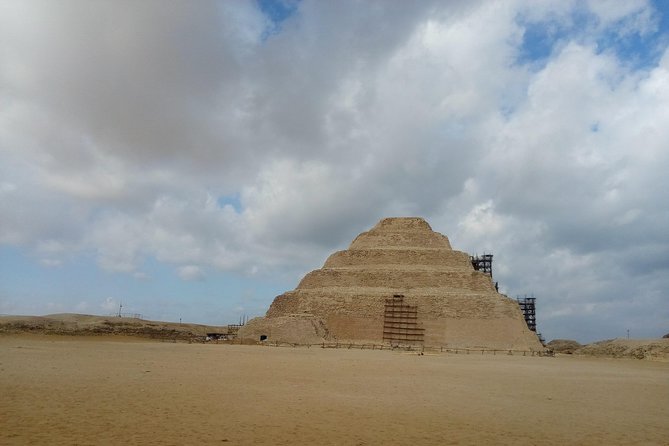
- Saqqara Step Pyramid context: You get the origin story of the first step-style pyramid before walking the wider necropolis setting.
- Memphis ruins with named statues: You focus on the remains tied to the second Ramses period, including major statue examples.
- Egyptian Museum with Tutankhamun treasures: You’re taken to the museum that holds an enormous collection, including the Tutankhamun discovery.
- Coptic Cairo stops: You visit a cluster of historic Christian sites in the Old Cairo area.
- Citadel and Khan el-Khalili: You end with big medieval architecture and a practical window for shopping.
Why this 2-day Cairo and Giza plan works
Cairo can feel like a lot, mainly because the city is huge and the traffic can be unpredictable. This tour solves the problem with a simple approach: early start, efficient routing, and a private guide who knows what to prioritize so you do not spend time guessing.
You also get a very clear mix of eras. Day 1 is built around the pyramid complex region and the ancient capital connections, while Day 2 shifts into Cairo’s museum world and then Old Cairo and Islamic Cairo. That rhythm helps your brain stay organized.
Finally, the tour is set up to be comfortable. You get private transportation with air conditioning and WiFi on board, plus bottled water and snacks. That matters more than it sounds after a few hours in the sun.
Other Cairo days people put in the same week:
- Cairo: Pyramids & Great Sphinx Private Tour with Camel Ride
★ 4.9 · 6,335 reviews - Tour to Giza Pyramids and The Egyptian Museum
★ 5.0 · 6,016 reviews - VIP All inclusive Best of the best Giza Pyramids,Sakkara,Memphis
★ 5.0 · 3,164 reviews
Day 1 at Giza: from the Great Pyramid to the Sphinx
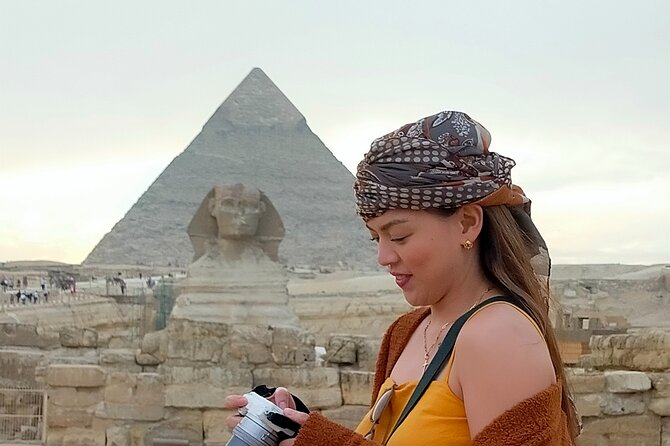
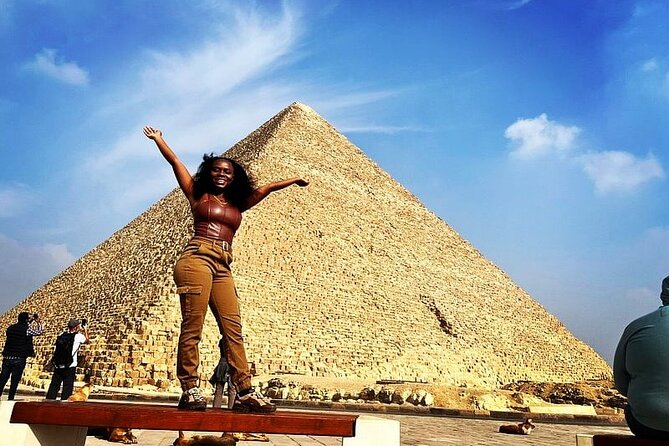
Your day starts at the Pyramids of Giza, and the plan is more than just “see the pyramids.” You begin with time around the Great Pyramid, described as one of the old Seven Wonders, built on the order of King Cheops. The scale details are the kind you only truly absorb after you stand there, where the numbers stop being trivia and start being reality: about 146 meters high, built with a vast stone count and size.
Then you shift into the classic “big picture” part of the visit. After you arrive and walk around, you drive to a panoramic view where you can see the pyramids lined up in one direction, which is ideal for both orientation and photos. You get a chance to catch memorial pictures while moving between viewpoints, and that small travel between stops saves your energy for the parts you will remember.
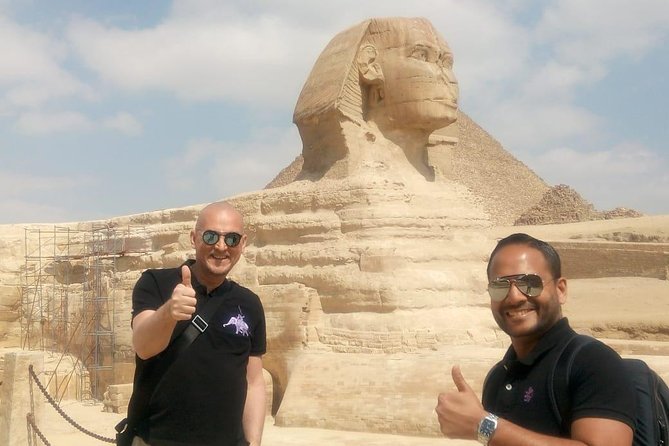
From there, you move toward the Sphinx area, with optional stops near the pyramid of Chefren and the pyramids of Menkaure as you travel. The end of this stretch is the moment most people come for: standing in front of the Great Sphinx, the lion body and human head you see in countless images. The description here includes the setting near the Valley Temple of the second pyramid, which gives you a better sense of what you are actually looking at, not just what it is called.
Practical tip: if you care about photos, you should lean into the guide’s suggested stop sequence. Viewpoints are chosen for visibility, and the panoramic drive is one of the easiest ways to get those “all in one frame” shots.
Memphis and Saqqara: the ancient capital story in two hits
After Giza, the tour pivots to Memphis and Saqqara, and that is a smart move. It turns the day from a single monument obsession into a storyline about Egypt’s political and religious geography.
Memphis is introduced as the first federal capital of Egypt, with its original names explained, including Mn-Nefer meaning the beautiful town, plus references to the White House translation tied to older naming (Pr-hedj). You also get a timeline anchor: it is described as founded around 3400 BC by order of the first king of the first dynasty, Minas.
What you see on the ground is focused on remains tied to the second Ramses period. The tour highlights specific sculpture examples, including the statue of Ramses II, an alabaster sphinx, and the holy trinity of Memphis featuring Ptah, Nfr-tm, and Sekhmet. That specificity helps you connect the ruins to the people and beliefs that shaped them.
Then you move to Saqqara, about 20 kilometers south of Giza. Here the story becomes even clearer. Saqqara is described as the oldest necropolis, connected to the same first federal capital era linked to Memphis. You walk into the Step Pyramid narrative first, with details about the Step Pyramid being the first pyramid built in the world, and the first complex built of stone on earth under King Zoser’s order.
From there, the stop expands beyond one monument. Saqqara is described as one of Egypt’s largest cemeteries until the Greek-Roman period. So even if you are not reading every inscription on the day, you are still getting the big idea: this was not one building, it was a long-lived burial landscape.
Time reality check: this is two days packed into multiple site visits. You will want comfortable shoes because you are walking around both the Giza region and necropolis areas.
Day 2 at the Egyptian Museum: Tutankhamun, 1901, and 120,000 objects
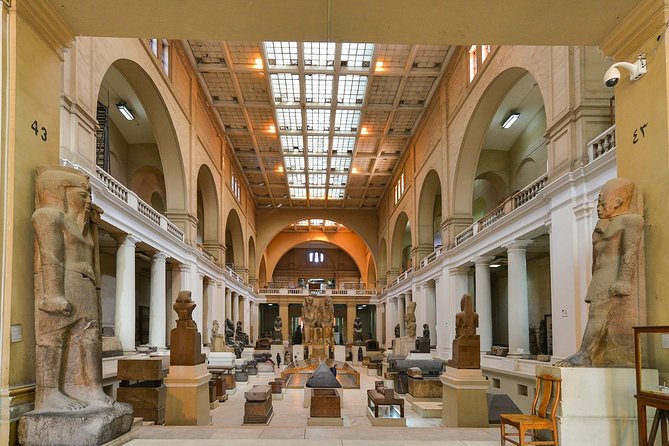
Day 2 starts with the Museum of Egyptian Antiquities, also called the National Egyptian museum. The introduction matters because it explains why this place is different from a typical museum stop. It is presented as one of the oldest and most important museums in the world, built in 1901, and framed like a mirror of ancient Egyptian history from pre-history through the Greek-Roman period.
The scale is huge. The museum is described as holding 120,000 pieces of antiquities, and the tour points you toward its most famous attraction: the Tutankhamun tomb treasures. The text ties the discovery to Howard Carter in 1922 in the Valley of the Kings, with the treasure collection described as more than 3,500 masterpieces.
Here is why I think this stop works well on a guided itinerary. A museum can swallow time fast if you are wandering alone. With a guide, you can focus on what matters most, get context in plain language, and avoid the feeling that you did not really see the real story.
Budget note: the tour includes admission for the museum, so you do not have to sort ticketing in the moment. That is a quiet win on a schedule-heavy day.
A different kind of day out of Cairo:
- From Cairo: Pyramids of Giza, Sphinx, Saqqara & Memphis Tour
★ 4.7 · 3,110 reviews - Cairo 8 Hour Private Tour of Pyramids, Egyptian Museum and Bazaar
★ 5.0 · 2,931 reviews - From Cairo: Half-Day Tour to Pyramids of Giza and the Sphinx
★ 4.6 · 2,891 reviews - Cairo: Pyramids, Sakkara & Memphis Tour with Lunch
★ 4.6 · 2,493 reviews
Coptic Cairo in Old Cairo: Christian sites with deep layers
After the museum, the route moves to Coptic Cairo, part of Old Cairo. This section is where the tour gets especially interesting if you like how cities evolve over time. You are not only moving through a religious timeline, you are seeing how a place can stay central even as power changes.
The focus is a cluster of Coptic and Old Cairo landmarks, including the Babylon Fortress and churches such as the Hanging church and the Greek church of St. George. The tour also points to other Coptic churches and historical sites in the same area.
A key piece of context is the Christian tradition connection to the Holy Family visiting the area. The tour description includes a stay around sites linked with saints Sergius and Bacchus, also referenced as Abu Serga. You are told that Coptic Cairo was a stronghold for Christianity until the Islamic era, and that many of the current church buildings were built after the Muslim conquest of Egypt in the 7th century.
What I like about this approach is the way it keeps the focus local. You are not jumping between faraway destinations. You are moving around the same neighborhood to see the city’s layered identity.
This is also a good pace reset after the museum, because you can look up, read surroundings, and absorb atmosphere while still having a planned route.
Cairo Citadel and Muhammad Ali Mosque: Saladin’s fortress to royal court
Next you go to Cairo Citadel, a major medieval fortress area built to protect the city from Crusaders. The date range given is 1176 to 1183 CE, and the tour names Saladin as the order behind it. You also get an important story detail: the tour description says stones from the Giza Pyramids were recycled to speed up the build.
That detail often changes how people look at both places. When you connect a medieval fortress to earlier monumental stone, you realize how Egypt’s past got reused, not sealed off.
The Citadel is described as covering 153,000 square meters and also as a royal court site over multiple eras, including Al-Nasir Muhammad ibn Qalaoun until Muhammad Ali Pasha, who is connected to key changes in the early 1800s. The tour describes Salamlik and Haremlik palaces and highlights the Muhammad Ali alabaster mosque, built between 1828 and 1848 CE, perched on the summit.
If you want a quick “what will I actually feel here” answer, it is this: you get a dramatic vantage and a strong sense of why rulers cared about controlling high ground. It feels less like random sightseeing and more like understanding how the city defended itself and ruled itself.
Khan el-Khalili Bazaar time: shopping with a plan
After the Citadel, you head to Khan al-Khalili Bazaar, an Islamic Cairo souk that is described as one of the main attractions for tourists and Egyptians alike. This stop is intentionally shorter, giving you time to walk, look, and buy without turning your day into an all-out shopping marathon.
Khan el-Khalili is a practical place to end a tour because it is naturally oriented for wandering. You can take in crafts, souvenirs, and the general street energy, and you have a guide to help you navigate what you are seeing.
Here is my practical advice: set your shopping targets before you enter the bazaar. Once you are inside, it becomes easy to lose track of what you wanted and end up buying items because you got tired. A guided schedule gives you the chance to choose, pay, and move on.
Price and logistics: what you really get for $154.29
The price is listed at $154.29 per person for a roughly 2-day private guided tour. On paper, that can look either fair or high depending on what you think is included.
In this case, the tour includes a lot that saves money and time in Cairo. You get:
- An expert Egyptologist tour guide who speaks your languages
- Entrance fees for all sights mentioned in the itinerary
- Bottled water and snacks
- Private transportation with AC and WiFi on board
- All taxes
- Pickup offered, plus a mobile ticket
What is not included is also clear: extra tickets such as pyramids inside and solar boat, plus personal needs and tipping. So if you have dreams of going inside the pyramids or adding the solar boat visit, you should budget extra.
Value perspective: you are paying for convenience, not just facts. Private AC transport plus included entrance fees is what prevents a day from turning into a series of small frustrations. For many people, that is the difference between a trip that feels effortless and one that feels stressful.
The tour is also private, meaning only your group participates. That matters if you travel with family, want a slower pace, or just do not want to get pulled around by strangers’ preferences.
Guide quality and the “feel safe” factor
A big pattern in the feedback is that the guides bring energy that stays friendly and helpful even with a tight schedule. Names like Ahmed Fadayat, Mohammed, Mostafa, Ahmed Farahat, and Osama show up as guides or guide team members. The tone described is upbeat and patient, and the guidance is often described as funny in a good way, not random jokes.
That matters at places like the pyramids and the museum, where the facts can get overwhelming fast. A good guide turns facts into a path you can follow. It also helps with practical on-site choices, like where to stand for photos and how to move efficiently between viewpoints.
Another praised element is service reliability. Pickup in a clean air-conditioned van and timely, organized itinerary planning appear repeatedly. That is not glamorous, but Cairo punishes sloppy planning. Getting it right is a real part of the experience.
Who this tour fits best
This tour is a strong fit if:
- You want the major Cairo and Giza highlights without building the plan yourself
- You like having context, not just standing in front of famous monuments
- You prefer private transportation and included admissions
- You want ancient Egypt plus Christian and Islamic Cairo in one compact schedule
It may be less ideal if:
- You want lots of free time at just one site, like spending a whole day at Giza
- You are the type who hates group movement and prefers wandering completely on your own
- You plan to do every possible extra ticket, since pyramids inside and solar boat are not included
How to make your two days feel smooth
Two days in Cairo and Giza can feel like a lot, but you can make it smoother with a few choices.
First, treat Day 1 like a “big monuments” day. You will see the pyramids up close and from panoramic viewpoints, then connect the ancient story through Memphis and Saqqara. Keep your expectations realistic: you are learning, not memorizing every detail.
Second, protect your museum time. The National Egyptian Museum stop is structured for you, and it helps to follow the guide’s order rather than trying to hit everything alone. If you have limited attention span in museums, still do not skip it. This is where Tutankhamun’s treasures come into the story.
Third, use the Coptic Cairo and Citadel blocks as your “city understanding” day. These stops make Cairo feel layered, not just famous. Once you grasp the idea that older material can be reused in later eras, the city stops being a jumble.
Finally, end with Khan el-Khalili like a bonus, not a mission. If you shop, shop with intent and keep some energy for the walk back to your pickup point.
Should you book this private guided tour?
I would book this tour if you want a guided, high-value highlights package that connects ancient Egypt to Cairo’s later religious eras in two full days. The biggest reason is the combination of included entrance fees, private AC transport with WiFi, and an Egyptologist guide who can explain what you are actually seeing.
If you already plan to spend extra time inside the pyramids or add the solar boat ticket, budget ahead since those extras are not included. Also note the tour requires good weather, so if conditions are poor, you may be offered a different date or a full refund.
If your goal is to leave Cairo with an organized understanding of Giza, Saqqara, Memphis, the museum treasures, Coptic Cairo, and the Citadel, this is a practical way to get it done.
FAQ
What time does the tour start?
The start time is 8:00 am.
Does the tour include pickup and private transportation?
Pickup is offered, and the tour includes private transportation with AC and WiFi on board.
Are entrance fees included?
Yes. Entrance fees for all sights mentioned in the itinerary are included.
What is included for the museum and historic sites?
The tour includes the National Egyptian museum visit, Coptic Cairo stops, Cairo Citadel, and Khan el-Khalili, with admission included for those listed sights.
What extras are not included?
Extra tickets like going inside the pyramids and the solar boat are not included.
Is this tour private?
Yes. It is a private tour/activity, so only your group participates.
Reviewed most recently around Cairo
- Giza pyramids, Saqqara and Dahshur day tour★ 5.0 · 20 reviews
- Pyramids of Giza, Sphinx and Egyptian Museum Day Tour★ 5.0 · 20 reviews
- Cairo Stopover Tour with Giza Pyramids, Sphinx, Egyptian Museum, and Old Cairo★ 5.0 · 20 reviews
- Private Experienced Tour for Camel ride during the sunset with Local Bedouin Dinner★ 4.0 · 20 reviews
- Discover Cairo by night★ 3.5 · 20 reviews
- Private Day Tour to Giza Pyramids, Sphinx, Coptic Cairo and Saint Simon Church in Cairo★ 4.5 · 20 reviews
- Luxor East and West Bank: Valley of the kings, Habu Temple,Karnak&Luxor Temples★ 5.0 · 20 reviews
- 10 Day Treasures of Egypt Tour Giza Pyramids & Cairo & Nile Cruise & Abu Simbel★ 5.0 · 20 reviews
2-Day Experiences, compared.
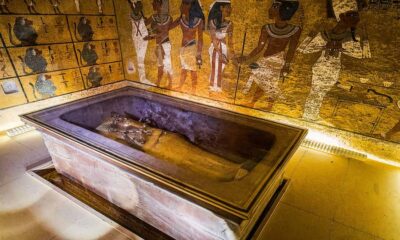
2-Day Luxor Tour with Hotel, Balloon, & Boat Ride
Read our review →
White & Black Desert tour 2 Days 1 night camping from Cairo.
Read our review →

White & Black desert camping tour 2 Days 1 night From Cairo
Read our review →
2 days cairo and giza attractions plus Gem, private tour
Read our review →
All Inclusive 2-Day Private Tour to All Pyramids and Cairo and 2 evenings
Read our review →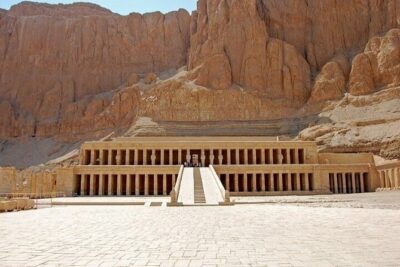
2-Day Top Attractions and Adventures Package in Luxor with Accommodation
Read our review →