
Reviewed · CAIRO TOURS
Fatimid Islamic Cairo Day Tour
Fatimid Cairo is interesting because it shows you how a city can be both a monument and a living neighborhood. I love that this tour gives you real time at the Museum of Islamic Art, including major Islamic works with links across India, China, Iran, and Spain. I also love the chance to visit Al-Azhar Mosque, tied to the start of the Fatimid era and still connected to scholarship today.
One possible drawback is pace. You pack four major stops into a single day, so if you want long pauses, extra questions, or a slow wander, you may feel a bit rushed. In the best-guided versions, guides like Ali or Sherif (and even Cherif, in some cases) keep the day organized, which helps you feel secure and get the most out of each site.
Key highlights you should know
- Museum time that actually matters, about 2 hours, not a quick photo stop
- Al-Azhar Mosque included with admission, with strong historical context from the Fatimid era
- Al-Muizz Li-Din Allah Street as an open-air museum, featuring 221 Islamic monuments
- Al-Ghouri complex visit, including the Qansuh Al-Ghouri Agency layout and merchant-focused architecture
- Private air-conditioned vehicle plus bottled water, so you can focus on the sights
- Highly rated guidance, with frequent praise for staying with you and helping you handle the day smoothly
Fatimid Cairo in one organized day: what the route really gives you
This is a 7-hour day tour that strings together four anchors of Fatimid Islamic Cairo, with hotel pickup and drop-off. Instead of bouncing randomly around the old city, the flow is built to help you connect art, education, city planning, and architecture in one storyline.
The day starts at the Museum of Islamic Art. From there, you move to Al-Azhar Mosque, which is less about sightseeing alone and more about understanding a living institution that began during the Fatimid period. Next comes Al-Muizz Li-Din Allah Street, where the “open museum” concept turns city streets into a timeline you can walk through. Finally, you end at the Mosque-Madrassa of al Ghouri, also known as the Qansuh Al-Ghouri Agency, where you see how religious life and commerce could share space and design.
Because it is a private tour for your group only, you are not stuck waiting behind a big, mixed crowd. That matters in Cairo, where the hardest part of sightseeing is often time and logistics, not the sights themselves.
More of Islamic Cairo:
- Old Cairo: Full-Day Islamic and Coptic Cairo Tour with Lunch
★ 4.6 · 688 reviews - 4-hours private Tour Islamic Mosque,Coptic Cairo &Khan el-Khalili
★ 5.0 · 489 reviews - Cairo Private Day Tours: Discover Islamic and Coptic Cairo
★ 4.5 · 231 reviews
Museum of Islamic Art: the fastest way to grasp Islamic art geography
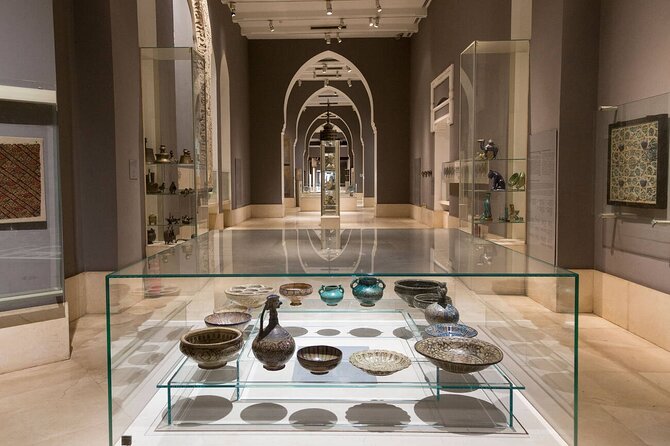
Your first stop is the Museum of Islamic Art for about 2 hours, with entrance included. This museum is described as the largest Islamic museum in the world, and that claim makes sense once you look at how wide its scope is.
What I like for your experience is the coverage across regions and styles. You get Islamic art connections from India and China, through Iran, across the Arabian Peninsula and the Levant, and onward to Egypt, North Africa, and Andalusia. In practical terms, that makes the museum a strong “orientation stop.” Even if you only understand a slice of what you see, you will start noticing recurring materials, design logic, and regional influences.
Why the time block matters: two hours is usually enough to avoid the classic museum problem where you feel like you saw everything and remember nothing. It gives you time to slow down, read labels, and look for patterns rather than treating it like a checklist.
If you care about a deeper look, this is also the kind of stop where a guide can make a big difference. A licensed guide can point you toward the most meaningful objects and explain why certain artistic styles spread or shifted. If your guide speaks a language you are comfortable with, that helps you get more meaning out of the museum, not just more images for your camera roll.
Al-Azhar Mosque: stepping into the Fatimid-era start of a major teaching tradition
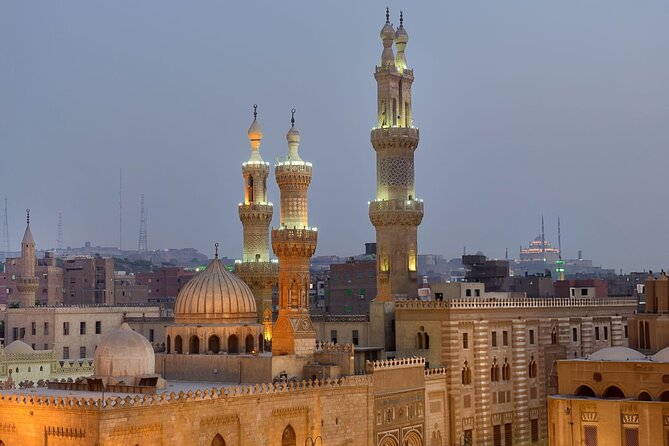
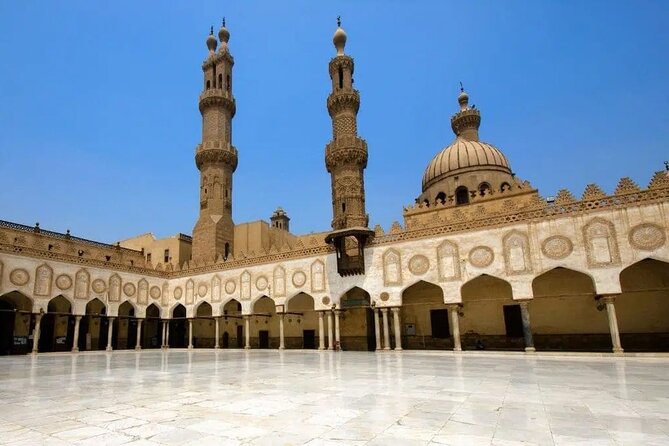
The second stop is Al-Azhar Mosque for about 2 hours, again with admission ticket included. This is one of the most important mosques in Egypt, described as a stronghold for spreading and teaching Islam. Construction dates back to the beginning of the Fatimid era.
What I like here, for real understanding, is the connection between place and institution. Al-Azhar is not only a historic building, it is also tied to education. It is described as the second oldest continuously existing university in the world after Al-Qarawiyyin University. That detail changes how you look at the mosque. You are not only viewing architecture, you are seeing a setting that has supported learning for centuries.
Two hours also gives you breathing room. Religious sites can be active and visitors can move differently than at museums. A dedicated time slot helps you avoid the rush feeling that makes cultural sites harder to process.
One consideration: if you expect everything to be explained at high speed, you might feel the day move quickly at this stop too, because the overall itinerary is structured to fit multiple major sights. If you prefer a calmer pace, mention it early to your guide.
Al-Muizz Li-Din Allah Street: 221 monuments you can feel in your feet
Next you visit Sharia Al Mu’izz Li-Din Allah, about 1 hour. This is one of the most compelling parts of the day because it reframes the old city itself as a museum.
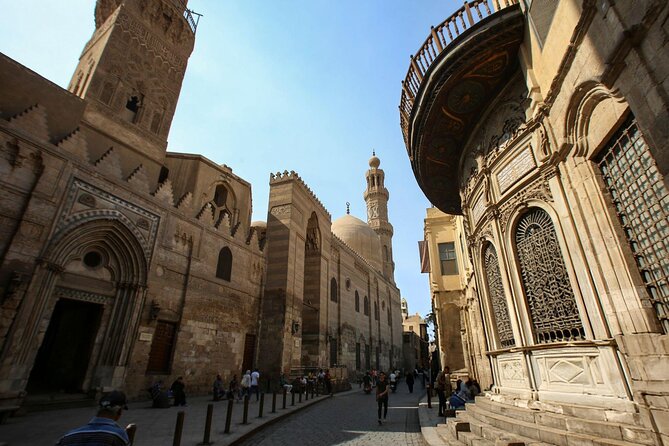
The street is described as containing 221 Islamic monuments, and it is called the heart of the old city of Cairo. The idea is that Cairo’s urban fabric became an open-air display of Islamic architecture and antiquities. You are not just looking at one building, you are moving along a corridor where different types of structures show up together.
Here are the concrete details worth knowing. The street stretches from Bab Zuweila in the south to Bab Al-Futuh in the north. It runs parallel to the Gulf and is described as the Great Street. Architecturally, it brings together Egyptian, Ottoman, Andalusian, and Byzantine influences, appearing in mosques, fountains, kottaib, takaya, and houses.
In other words, this stop is about patterns. You start to recognize how religious buildings sit next to civic spaces, how water features connect to daily life, and how education and worship could coexist in the same urban plan.
The one-hour time block is the trade-off. One hour is enough to get the key sights and absorb the overall story, but it is not enough if you want to linger on every monument. If you love slow street photography and long label-reading, this portion might feel short. The best approach is to focus on learning the “why” behind the street’s layout, not trying to do an exhaustive count.
A different kind of day out of Cairo:
- Cairo: Pyramids & Great Sphinx Private Tour with Camel Ride
★ 4.9 · 6,335 reviews - Tour to Giza Pyramids and The Egyptian Museum
★ 5.0 · 6,016 reviews - VIP All inclusive Best of the best Giza Pyramids,Sakkara,Memphis
★ 5.0 · 3,164 reviews - From Cairo: Pyramids of Giza, Sphinx, Saqqara & Memphis Tour
★ 4.7 · 3,110 reviews
Mosque-Madrassa of al Ghouri (Qansuh Al-Ghouri Agency): where commerce shows up in design
Your final major stop is the Mosque-Madrassa of al Ghouri, described as the Qansuh Al-Ghouri Agency established in 909 AH to 1504 AD, during the reign of Qansuh Al-Ghouri. It is located on Muhammad Abdo Street, off Al-Azhar Street.
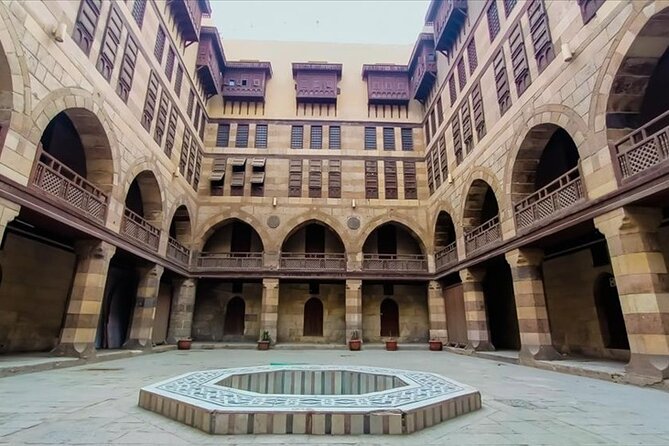
This is a fascinating end point because it is not only about worship. It is about how a city functioned. The agency is described as an establishment, like an agency or hotel, designed with a rectangular open courtyard and rooms on five floors. The main facade is on the south side, and the main entrance opens toward the courtyard.
You get specific architectural details that make the visit easier to understand. There is a stone staircase leading to the first floor. The first floor is said to have about 30 holders, and the three upper floors have 29 houses. It is believed the ground and first floors served as stores for merchants, and that many visitors were merchants.
Why this matters for you: it helps you see that Islamic Cairo’s monumental buildings were often tied to everyday economic life. A mosque-madrassa is not an isolated world. It can be part of a wider system where merchants, students, and travelers all cross paths.
Two hours is a decent amount of time to actually take in the layout. Courtyard-centered buildings can be mentally tricky at first, because your eyes try to focus on one doorway or one wall. Time helps you map the space: entrance, courtyard, different floors, and the way rooms face inward.
Private vehicle, licensed guide, and the small things that make Cairo feel manageable
Logistics can make or break a Cairo day tour. This one includes a private air-conditioned vehicle and bottled water, plus a professional licensed tour guide. That combination is not glamorous, but it is the difference between enjoying the day and spending it fighting heat, timing, and directions.
The tour also includes pickup from your hotel and ends with a transfer back. That matters in a place where travel time can fluctuate. If you are short on days in Cairo, minimizing unnecessary trips is usually the smart move.
Because it is private for your group only, you can also expect a more flexible flow inside reason. Your guide can keep the pace aligned with your interests, and you will not get interrupted by other groups trying to squeeze past.
One more detail that can help: mobile ticket is included. In Cairo, where you might be asked to show something quickly at the entrance, having your ticket ready is one less stress point.
Based on the feedback style tied to guides like Ali, Sherif, or Cherif, the guidance is often described as attentive and focused on keeping you comfortable. Some guides are also credited with helping tourists avoid trouble by staying close and handling interactions efficiently. That kind of support is not about drama, it is about making the day feel predictable.
Price and value: is $130 per person fair for this set of stops?
At $130 per person for about 7 hours, you are paying for four things that add up fast if you do them on your own: a licensed guide, private air-conditioned transportation, bottled water, and entrance fees.
Entrance fees are explicitly included. That is important because mosque and museum visits can require tickets or timed entry planning. When entrance is already handled, you avoid one of the biggest DIY headaches: trying to figure out what is required for each stop while you are already tired from travel.
The private vehicle is also a value driver. This itinerary covers multiple locations tied to historic Fatimid Cairo. Paying for door-to-door transportation can be cheaper than you think once you factor in how long local transit and walking time might take, especially during hot hours.
Where you should be a bit careful is pace versus expectations. This itinerary is structured. If you come hoping for a long, unhurried stroll through every monument on Al-Muizz Street, you might feel the schedule tightness. If you come wanting a coherent overview with high-quality context and smooth logistics, you are likely to feel the value is solid.
Overall, this experience has very strong satisfaction signals, with a 4.9 rating and 97% recommendation. The consistent message is that the guide effort and the organization of the day are the real wins.
Who should book this Fatimid Islamic Cairo day tour
This tour is a good match if you want:
- A guided, coherent introduction to Fatimid-era Cairo highlights
- A strong pair of stops for learning, Museum of Islamic Art plus Al-Azhar Mosque
- A mix of architecture and urban history, including Al-Muizz Street and the al Ghouri complex
- Convenience, with pickup, private A/C transport, and entrance fees included
It may not be your best choice if:
- You want lots of free time at each stop to wander independently for long stretches
- You plan to add several extra targets that are not part of the set route, because the day is built around these four anchors
- You get frustrated by religious sites feeling active or different from museums, since it is scheduled around real places that function beyond tourism
If your group includes people who love design and institutions, this itinerary tends to land well. Museums and mosques naturally attract that kind of curiosity. If your group is a bit mixed, the guide can help keep everyone oriented.
Should you book it, or build your own Fatimid Cairo day?
If you want a day that feels organized and meaningfully guided, I would book this. The big reason is the balance of included costs. You are not just paying for a driver. You are also getting a professional licensed guide and entrance fees bundled into a private, hotel-to-hotel schedule.
It is especially worth it if it is your first time tackling Cairo’s Islamic Cairo sites. Museum of Islamic Art gives you the artistic map, Al-Azhar gives you the education anchor, Al-Muizz Street shows you city planning through 221 monuments, and al Ghouri shows you architecture tied to commerce.
My only caution is this: go in with realistic expectations about time at each stop. Two hours at museums and mosques is good, but it is not a full day of wandering. If you want a slow, deep personal exploration, consider adding extra independent time after the tour or choosing a different format. If you want smart coverage with a guide who keeps the day smooth, this one fits.
FAQ
What is the duration of the Fatimid Islamic Cairo day tour?
The tour is listed at about 7 hours.
What stops are included during the day?
The itinerary includes the Museum of Islamic Art, Al-Azhar Mosque, Sharia Al Mu’izz Li-Din Allah, and the Mosque-Madrassa of al Ghouri (Qansuh Al-Ghouri Agency).
Are entrance fees included?
Yes. Entrance fees are included for the stops on the itinerary.
Is pickup from the hotel included?
Yes. Pickup is offered from your hotel, and the tour ends with a transfer back to your hotel.
Is the tour private?
Yes. It is a private tour/activity, meaning only your group participates.
What is included in the price, and is tipping included?
The tour includes bottled water, a private air-conditioned vehicle, a professional licensed tour guide, and entrance fees. Personal expenses and tips are not included.
FAQ
What is the cancellation policy?
Free cancellation is available up to 24 hours in advance for a full refund.
Is there a mobile ticket?
Yes, the tour includes a mobile ticket.
Reviewed most recently around Cairo
- Giza pyramids, Saqqara and Dahshur day tour★ 5.0 · 20 reviews
- Pyramids of Giza, Sphinx and Egyptian Museum Day Tour★ 5.0 · 20 reviews
- Cairo Stopover Tour with Giza Pyramids, Sphinx, Egyptian Museum, and Old Cairo★ 5.0 · 20 reviews
- Private Experienced Tour for Camel ride during the sunset with Local Bedouin Dinner★ 4.0 · 20 reviews
- Discover Cairo by night★ 3.5 · 20 reviews
- Luxor East and West Bank: Valley of the kings, Habu Temple,Karnak&Luxor Temples★ 5.0 · 20 reviews
- Private Day Tour to Giza Pyramids, Sphinx, Coptic Cairo and Saint Simon Church in Cairo★ 4.5 · 20 reviews
- 10 Day Treasures of Egypt Tour Giza Pyramids & Cairo & Nile Cruise & Abu Simbel★ 5.0 · 20 reviews
Cairo Tours, compared.

Pyramids & Great Sphinx Private Tour with Camel Ride
Read our review →
Tour to Giza Pyramids and The Egyptian Museum
Read our review →
VIP All inclusive Best of the best Giza Pyramids,Sakkara,Memphis
Read our review →
Pyramids of Giza, Sphinx, Saqqara & Memphis Tour
Read our review →
Cairo 8 Hour Private Tour of Pyramids, Egyptian Museum and Bazaar
Read our review →
Half-Day Tour to Pyramids of Giza and the Sphinx
Read our review →

Private ViP all-inclusive Giza Pyramids,Sphinx,Inside Pyramid
Read our review →Browse the lists this tour appears in