
Reviewed · ABU SIMBEL
3-Day Luxor Aswan and Abu Simbel Historical Sites Private Tour
This tour is interesting because it compresses three big “Egypt hits” into 3 days, without making you wrestle with tickets or taxis. You move from Luxor’s royal monuments to Aswan’s island temples, then make the long jump to Abu Simbel, one of Egypt’s most dramatic sights. It’s set up as a private experience, so your guide can pace things for your group.
I love that first-class train tickets between Luxor and Aswan are included, plus you get round-trip hotel pickup and drop-off. It also feels practical that you have an Egyptologist guide to explain what you are seeing, instead of wandering around like you are decoding a mystery alone. In the little details, like the walk through Karnak and the way the guide sets up what you should look for, you can feel the value.
One possible drawback: entrance fees are not included, and some tomb and temple interiors are restricted for guides. For example, at Valley of the Kings you only get a guided explanation of what to look for inside, and King Tutankhamun can cost extra on site.
Key highlights you’ll feel fast
- First-class train Luxor to Aswan included, so you skip ticket stress and keep the schedule moving
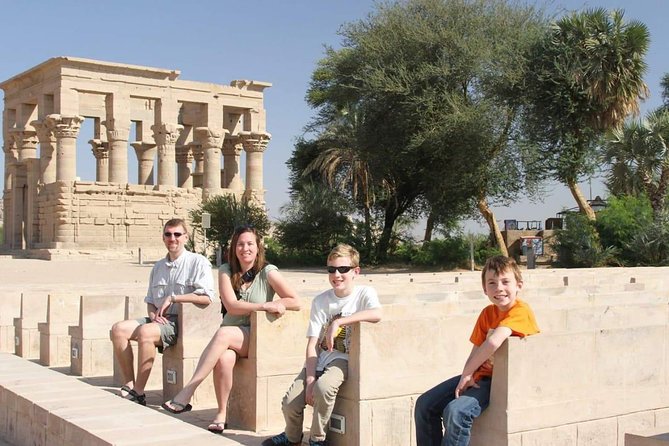
- Philae Temple reached by motorboat, then explored on foot with context from an Egyptologist
- Big, guided storytelling at each stop, from Hatshepsut’s gender-bending reign to the UNESCO relocation of Abu Simbel
- Comfort-focused logistics, with air-conditioned vehicle transport and parking and fuel charges handled
- Some interiors are off-limits to guides, so you’ll rely on explanations, photos, and illustrations for parts of the visit
A 3-day sprint that still feels like you get the meaning
If you only have a short window in Egypt, this is the kind of plan that saves real time. Luxor and Aswan are close enough for a day of temples, but Abu Simbel sits far out to the south. Doing all three by yourself means coordinating buses or private cars, chasing opening hours, and figuring out how to get across the Nile and back again.
Here, the heavy lifting is already done for you. You travel by air-conditioned vehicle, your pickup and drop-off are arranged, and the big transfer between Luxor and Aswan is handled with first-class rail. That matters because the temples are impressive, but Egypt logistics can also eat your energy.
And since this is private, the experience is less about “follow the group” and more about keeping your eyes on the right details. If you want the highlights without turning your trip into a full-time job, this route is built for that.
More ways to reach Abu Simbel:
- Luxor: Abu Simbel Temple Private Guided Day Trip with Lunch
★ 4.6 · 546 reviews - 4 Nights Luxor to Aswan Nile cruise with Abu Simbel&Air Balloon
★ 5.0 · 155 reviews - 4 Days Aswan and Luxor Nile cruise&Abu Simbel by plane from Cairo
★ 5.0 · 155 reviews
Day 1 in Luxor: West Bank tombs, Hatshepsut, and Karnak’s forest of columns
Your first day covers the classic Luxor mix: the West Bank for royal burials, then the East Bank temples, ending with Luxor Temple.
Valley of the Kings and the rule about tomb access
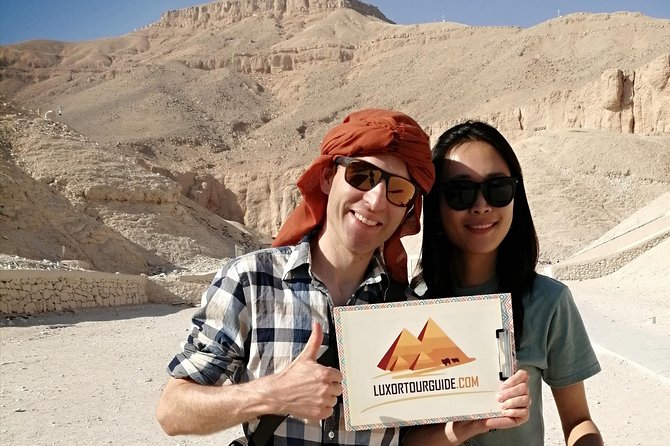
You start at the Valley of the Kings, where the pharaohs of Thebes were buried. You’ll have a brief stop at the visitors area, and your guide will explain what you will see inside the decorated tomb rooms. There’s an important limitation: guides are not permitted inside the tombs themselves.
If you want to add the tomb of Tutankhamun, plan for an extra charge paid directly. The upside is that your guide can still help you make a smart choice about which tombs are worth your time. You just should know that your guided access inside the tomb may be limited by the rules.
Temple of Hatshepsut: a queen’s power told in stone
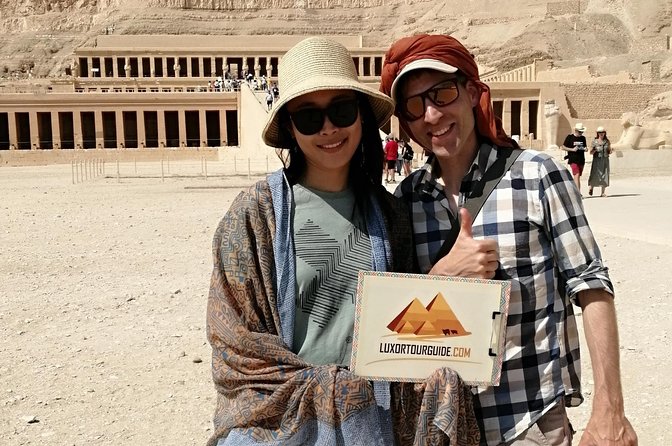
Next comes the Temple of Hatshepsut, one of the most striking monuments in Egypt. Your guide shares the story of Hatshepsut, the female ruler who took on a male presentation to gain and hold the throne. You’ll also get time to roam the courtyards at your own pace and look closely at the carved details and hieroglyphic decoration.
This is a stop I like because it feels human. You’re not just staring at old rocks, you’re learning how power worked in ancient Egypt and why these choices mattered.
More history days in Luxor:
- Sunrise Hot Air Balloon Over the Historical sites in Luxor
★ 5.0 · 697 reviews - Explore the history and treasures of Luxor on a full-day tour
★ 5.0 · 21 reviews - From Cairo: Private Full-Day Tour of Historical Alexandria
★ 4.1 · 1,155 reviews - Old Cairo Guided Walk Tour: History, Culture & Street Bites
★ 4.6 · 633 reviews
Colossi of Memnon: what’s left when the rest is gone
The Colossi of Memnon are short and sweet. These two giant statues mark where Amenhotep III’s funerary temple stood. Even with only the remaining statues, you get a clear sense of scale, which helps you understand the ambition behind the lost complex.
This is a good “breather” moment on a packed day, but don’t treat it as a throwaway. The comparison of what remains versus what once existed is part of the story.
Karnak: walking the Avenue of Sphinx and the Great Hypostyle Hall
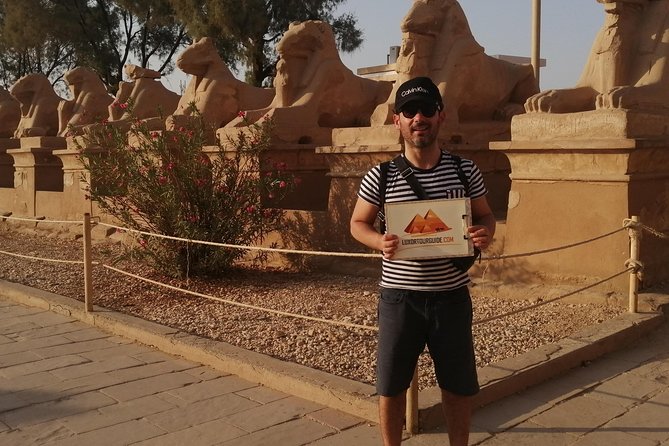
Then you move into Karnak, usually the temple that makes people stop talking for a minute. You enter along the Avenue of Sphinx, and your guide explains how the massive facade was constructed. Inside, you’ll see how different pharaohs added to the complex over time, so the further you walk, the older the layers feel.
The main showpiece is the Great Hypostyle Hall, where 134 columns rise like an ancient forest. Your guide will point out details, and you’ll also have time to keep exploring on your own after the guided portion. There’s even a sacred lake area where, long ago, offerings and purification rituals were part of the temple’s function.
Luxor Temple: hieroglyphs, Ramses II, and an obelisk legacy
You finish the day at Luxor Temple, connected to Karnak in ancient times by the two-kilometer Avenue of Sphinx. The temple is dominated by statues linked to Ramses II, and it has survived Nile floods, invasions, and thousands of years of exposure.
Inside, the walls and columns carry intricate hieroglyphics. Your guide helps you make sense of what you’re seeing, which makes the place feel less like a pass-or-fail photo stop. You’ll also hear how Alexander the Great appears in Luxor Temple’s story, and you can see the meaning behind an obelisk legacy, including the fact that one of the original pair now stands in Paris.
Day 2 Aswan: Philae on an island, red granite at the quarries, then the High Dam
Day 2 shifts from Luxor’s temple blocks to Aswan’s mix of ancient and modern.
Philae Temple: relocated by necessity, still beautiful
You tour Philae Temple by private guided visit, starting with a short motorboat ride to the island. The reason for this island setting is key. When the High Dam changed Nile water levels, Philae was moved to its current location, about 500 meters from the original site.
Dedicated to goddess Isis, Philae’s shrines and sanctuaries connect to the myth of Isis and Osiris. You walk through with your guide, then get free time to explore further on your own. What I like here is that you get both the story and the setting. The island layout matters because you are seeing how religion used geography.
Unfinished Obelisk: the “almost” that teaches you how it was made
Then you head to the Unfinished Obelisk in Aswan’s granite quarries. This is not a grand complete monument, but it’s fascinating because it shows the process. A red granite obelisk was carved, and when a crack was discovered, the piece was abandoned where it lay.
Your Egyptologist guide explains how a one-tonne obelisk was carved and why the crack caused the plan to stop. It’s a great reminder that ancient engineering was not magic. It was skilled work, vulnerable to mistakes, and shaped by real materials.
Aswan High Dam: a modern project with a big payoff
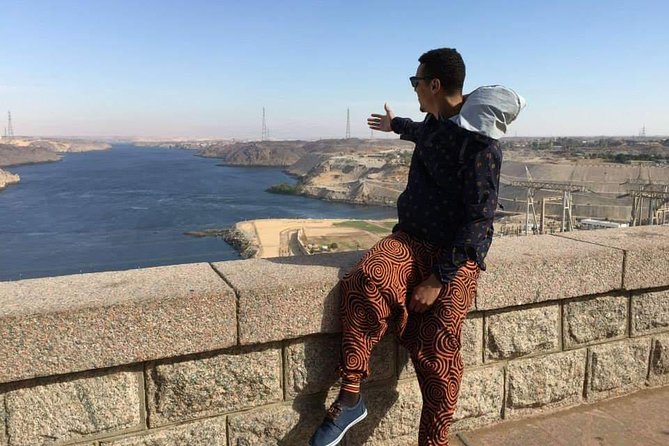
Next comes the Aswan High Dam, a modern achievement that took 10 years to build from 1960 to 1970. You’ll see Lake Nasir, described as the second largest artificial lake in the world, and you’ll cross the friendship emblem.
This part is a useful contrast after Philae. You see how one huge infrastructure project forced ancient sites to adapt. Even if you are purely there for temples, the High Dam stop helps you connect the dots behind why relocation happened.
Day 3 Abu Simbel: the long day that makes the whole trip feel worth it
Abu Simbel is where the itinerary earns its keep.
You travel there by vehicle from Aswan, and the day is long, with about 8 hours for the Abu Simbel visit. Your guide stays with you, and you get a personalized private experience at the site.
Why Abu Simbel looks the way it does
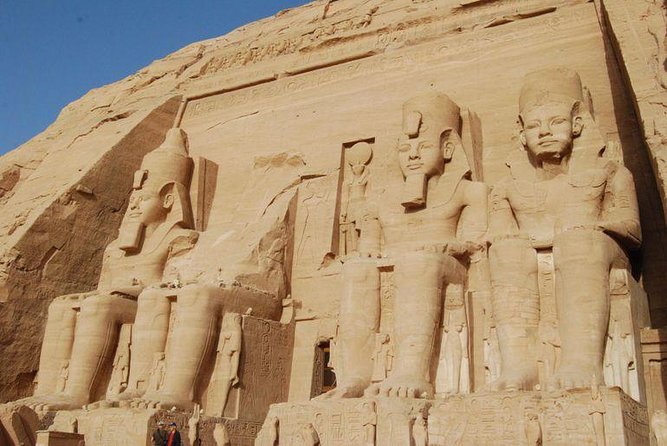
Your guide explains the UNESCO-led relocation of the entire cliff face to higher ground. You’ll also hear that Abu Simbel was discovered by accident in 1813. Those two facts matter because they change how you look at the temples. They are not just ancient monuments in place, they are monuments saved and rebuilt to survive modern change.
Four pharaohs and the two temples you can’t fully enter with a guide
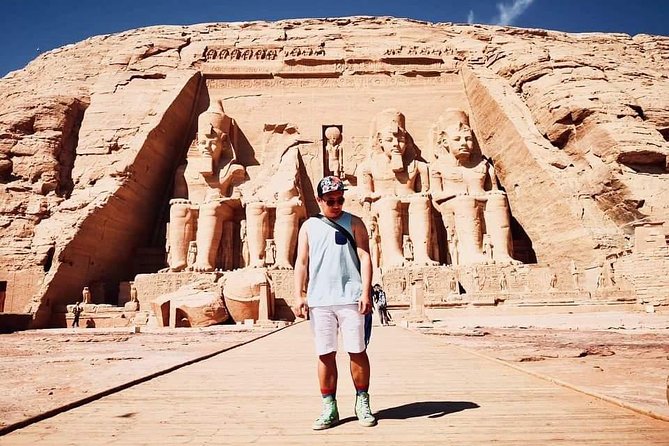
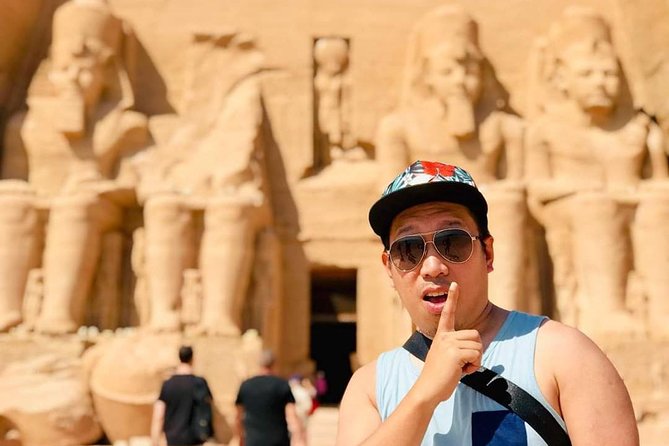
The complex features rock-hewn temples, with four rock-hewn pharaohs at the entrance area. The highlight is the Great Temple of Ramses II, and there is also the smaller Temple of Hathor.
One limitation is important: due to the volume of visitors, guides are not permitted inside either temple. Instead, your guide uses photos and illustrations to explain what you would see inside. So you can still learn the symbolism and layout, but you won’t have a guided walkthrough inside the rooms themselves.
Practical tip from how these restrictions tend to feel on the ground: go in with a few questions you want answered, and lean on your guide’s explanations outside the restricted areas. Even without interior guidance, Abu Simbel stays powerful.
Included transport and tickets: the real value is time saved
This tour is priced like a package, but the standout value is what it removes from your to-do list.
Luxor to Aswan by first-class train, plus Philae by boat
The big win is that the first-class train tickets between Luxor and Aswan are included. You also get the boat journey to Philae Temple handled as part of the day. These are the two items that most often become headaches when you do it solo.
You also have round-trip transportation from your hotel, plus an air-conditioned vehicle during the land segments. Parking fees, fuel surcharge, driver, and all service charges and taxes are included as well.
Mobile ticket, private pacing, and group discounts
A mobile ticket is included, which is one less document to worry about. The tour is private for your group, even though group discounts are listed as a feature, meaning you are not stuck in a huge crowd experience with strangers guiding your rhythm.
What is not included, so budget for it
Entrance fees to all sites are not included. Food and drinks are not included unless specified. Personal expenses and gratuities are also on you, with gratuities recommended.
So think of the package as handling logistics plus the guide experience. You still plan your day-to-day spending for tickets, meals, and tips.
What your Egyptologist guide can do, even when interiors are restricted
A lot of people worry that restrictions mean you lose the meaning. You don’t, but you should know how the guide will work with the limits.
At Valley of the Kings, guides are not permitted inside the tombs. Instead, your guide provides a guided explanation of what to look for in the decorated rooms. If you choose to visit the tomb of King Tutankhamun, it’s an extra cost paid directly.
At Abu Simbel, the rule is similar but even more noticeable, since guides cannot go inside the Great Temple of Ramses II or the Temple of Hathor. You will still get history and interpretation using photos and illustrations, so the symbolism and layout get explained in a way that stays useful.
This is one reason I like having a guide on this kind of trip. You might not get every minute inside every room with narration. But you can still connect the dots quickly, and that makes your photos more than just pretty stone shots.
The guides and vibe: personal, focused, and practical
In the real world, a lot depends on the guide. The names that come up with praise around this tour style include Khaled, who is described as helpful, informative, and charismatic. People also mention guides who focus on the best tomb choices in the Valley of the Kings and smart timing so you get a better experience.
There’s also coordination support from Mohamed, including help shaping logistics to match your needs. Mahmoud is another driver name that appears with praise for navigating the roads smoothly.
I’d treat this as a sign of a service that pays attention to the day-to-day details. When you are doing Luxor, Aswan, and Abu Simbel in three days, you need that.
Who should book this tour, and who should maybe rethink it
This is a strong fit if you:
- want the main highlights in Luxor, Aswan, and Abu Simbel without planning the moving parts
- prefer a private tour so you can go at your group pace
- like temple archaeology and want explanations, not just locations
- can handle moderate walking, with the understanding that some days are long
It might be less ideal if you:
- want a slow museum-style trip and hate long days
- get stressed by the idea that guides cannot enter certain tomb or temple interiors with you
Price and value check for $251.29 per person
At $251.29 per person, the price is easiest to judge by what’s included. You are not just buying a guide. You are buying:
- an Egyptologist guide
- hotel pickup and drop-off
- an air-conditioned vehicle
- first-class train tickets from Luxor to Aswan
- a boat journey to Philae
- parking fees, fuel surcharge, and driver and service charges and taxes
What you are not buying is the site entry itself, meals, drinks, and gratuities. So your true total depends on entrance fees and your spending style.
Still, if you’ve ever tried to build a similar 3-day plan yourself, you know how quickly time and stress pile up. The biggest practical value here is that the transport and the key transfers are handled, so you spend your energy on the monuments instead of on schedules.
Also, bookings are often made about 11 days in advance on average. If you want a smoother experience with fewer surprises, I’d plan early rather than waiting until the last minute.
Should you book this 3-day Luxor, Aswan and Abu Simbel tour?
I’d book it if you want a tight, guided route that hits the must-see sites and removes the transport chores. Abu Simbel alone is a reason, but the real win is that the plan links it to Luxor and Aswan in a way that feels coherent, not random.
Before you say yes, check two things in your own head:
- Entrance fees and meals are extra, so you should budget for that.
- Some interiors are restricted for guides, so your visit includes context and explanations, not an inside walkthrough in every room.
If that fits your travel style, this is one of the more practical ways to see a lot of Egypt fast, with Egyptologist guidance and real logistics handled for you.
FAQ
Is hotel pickup and drop-off included?
Yes. Hotel pickup and drop-off are included as part of the tour.
Are entrance fees to Luxor, Aswan, and Abu Simbel included?
No. Entrance fees to all sites are not included, and admission tickets are listed as not included.
How do we travel between Luxor and Aswan?
First-class train tickets between Luxor and Aswan are included.
How long is the Abu Simbel visit?
The Abu Simbel day is listed as approximately 8 hours.
Is this tour private?
Yes. It is a private tour, and only your group will participate.
What is the cancellation policy?
You can cancel for a full refund up to 24 hours in advance of the experience start time. If you cancel less than 24 hours before, the amount you paid is not refunded.
Reviewed most recently around Luxor
- Camel or Horse ride on west bank★ 5.0 · 20 reviews
- Nefertari and King Tut’s Tombs, Hatshepsut and More in Luxor★ 4.5 · 20 reviews
- Private Day Tour of Luxor★ 5.0 · 20 reviews
- Private Transfer from Luxor to Marsa Alam or vice versa★ 5.0 · 20 reviews
- Private Transfer Luxor to Aswan★ 5.0 · 20 reviews
- 5 Days Nile Cruise from Luxor to Aswan with Hot Air Balloon★ 5.0 · 20 reviews
- Private Full Day Tour: Dendera & Abydos Temples from Luxor★ 5.0 · 20 reviews
- Full Day Luxor East and West Banks Tour With Lunch★ 5.0 · 20 reviews
Abu Simbel, compared.

4-Days Nile Cruise From Aswan To Luxor including Abu Simbel and Hot Air Balloon
Read our review →
4-Day 3-Night Nile Cruise from Aswan to Luxor&Abu Simbel+Balloon
Read our review →
4-Day 3-Night Nile Cruise from Aswan to Luxor including Abu Simbel, Air Balloon
Read our review →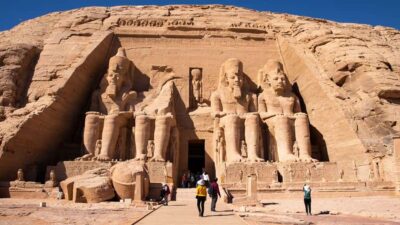
Abu Simbel Temple Private Guided Day Trip with Lunch
Read our review →4-Days Nile Cruise From Aswan To Luxor including Abu Simbel and Hot Air Balloon
Read our review →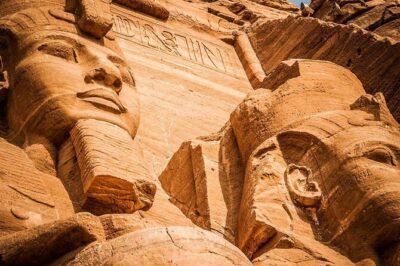
Private Day Tour to Abu Simbel Temples from Aswan
Read our review →4 Days Nile Cruise from Aswan to Luxor including Abu Simbel and Hot Air Balloon
Read our review →Browse the lists this tour appears in